
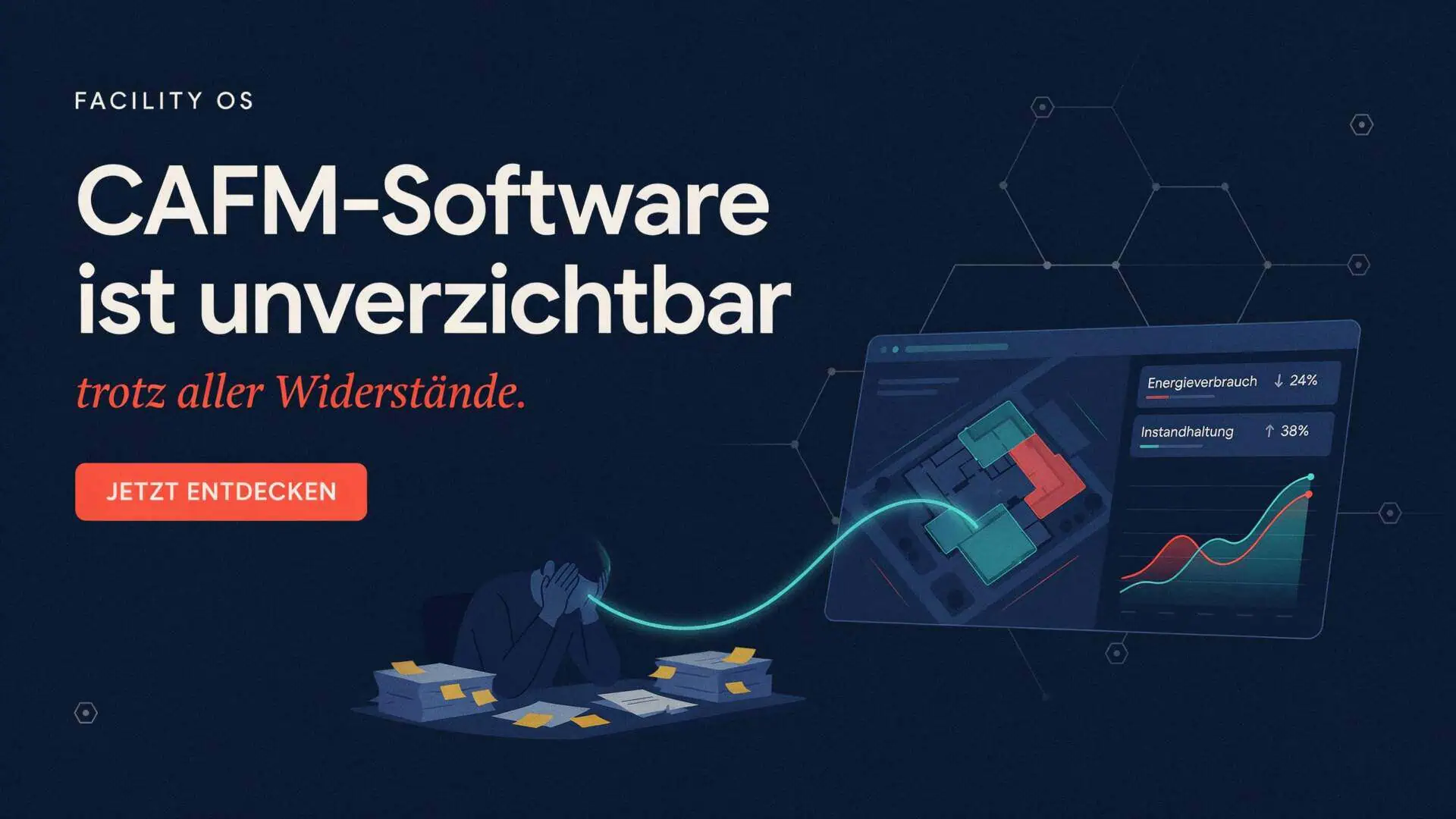
TL;DR: CAFM Software (Computer-Aided Facility Management demonstrably increases efficiency in building operations — reduces operating costs, minimizes downtime, and creates transparency regarding spaces, maintenance cycles, and resources. Nevertheless, implementation fails in many organizations not due to technology, but due to institutional stubbornness, Data Anxiety and the underestimated influence of Mr. Krause from building services.
Let me start with a statement that I will immediately regret: The skeptics are not always wrong. CAFM systems are expensive, complex, and are often advertised by manufacturers as "holistic platform solutions with AI-supported Insights" – a phrase that has about as much substance as a floor plan without a scale. And yet: The alternative, i.e., the continued operation of properties via paper records, verbal requests, and collective amnesia, is no longer a position in 2026 that can be defended in a strategy meeting without someone discreetly looking towards the door.
CAFM stands for Computer-Aided Facility Management and refers to software systems that digitally map all processes related to the operation, maintenance, and management of buildings and infrastructure. According to the GEFMA Guideline 400, the spectrum covers everything from space management and maintenance planning to energy data collection and contract management — in short: everything that keeps facility managers busy every day and which, without software, originates somewhere between three Excel spreadsheets, a SharePoint folder named “current_documents_final_(3)_OK_02b”, and largely in the head of Heinz the building technician (sorry if Heinz Krause, who is actually a building technician by profession, feels addressed in real life...).
I would like to explain, why CAFM software is not is optional, which resistances systematically block their implementation, and why the most common counterarguments are less convincing upon closer inspection than their reputation.
What is CAFM software — and what does it really promise?
CAFM software is a digital control system for building operations. The core functions of modern systems — for example, from providers like Planon, Archibus, iX-Haus, or MCS Solutions — typically include:
- Space Management: Recording, visualization, and evaluation of usable areas according to DIN 277 or GIF standard
- Maintenance Management: Planning and documentation of maintenance measures, including legally required inspection obligations
- Contract Management: Management of service provider and rental agreements with automated terms and notice periods
- Energy management: Recording and evaluation of consumption data for electricity, heat, and water
- Helpdesk and Ticketing: Control of fault messages and service requests
This sounds sober — and it is. CAFM software is not a luxury item, but Operational Infrastructure. The question of whether you need it is about as meaningful as the question of whether a surgeon actually needs sterile operating instruments. Technically, one could do without it. But practically, it would be a very interesting experience ;-)
Transparency instead of guesswork: How CAFM makes operational data usable
The central promise of CAFM is not Efficiency — that is the Selling point. The actual promise is Visibility. Whoever knows which systems were maintained when, which areas are actually used, and which contracts expire in six weeks, makes better decisions. Sounds trivial. But it isn't.
According to a study by the consulting firm Deloitte in 2023, billions of costs are incurred annually in German companies due to unplanned system failures — a significant portion of which could be avoided through consistent maintenance documentation and predictive maintenance. CAFM systems with integrated maintenance planning reduce unplanned downtimes by an average of 15 to 30 percent, according to GEFMA (Guideline 430). on average by 15 to 30 percent.
The irony is: these figures exist. Decision-makers know them. And yet, in a surprising number of organizations, maintenance plans are still sitting in a Leitz folder in the basement — which, by the way, no one has seen since the move in 2019 ;-)
Legal certainty and compliance: What happens when no one has documented
CAFM is not just an efficiency tool — it is also a liability management instrument. The legal requirements for operator responsibility in Germany are complex and far-reaching due to BetrSichV, DGUV regulations, VDMA standards, and numerous state-specific building codes.
Specifically, this means: whoever cannot prove that an air-conditioning system was maintained on time is personally liable in the event of damage — not the company, not the limited liability company, but the responsible person. With their name. And address.
A well-implemented CAFM system documents these proofs automatically and in an audit-proof manner. A poorly implemented CAFM system does too — but that's another chapter...
Space optimization: The most expensive room is the one used incorrectly
Especially in times of hybrid work, space management has become a strategic issue. Companies in major German cities pay between 20 and 45 euros per square meter for office rent — and, according to a study by the Fraunhofer Institute for Industrial Engineering and Organization (IAO) from 2022, they only use an average of 60 to 70 percent of their office space regularly.
CAFM systems with occupancy analysis enable well-founded space decisions instead of guesswork. This saves — depending on the company size — significant rental costs. Or, to put it another way: the system sometimes pays for itself solely through a single well-founded decision. through space reduction.
The Landscape of Resistance: An Ethnographic Journey
Let's get to the actually interesting part: the reasons why CAFM projects fail — or don't even start. They can be roughly divided into three categories, which I would like to describe here with the affectionate distance of a field anthropologist.
"We've always done it this way" – the argument for maintained inefficiency
This is the oldest and most honest argument against any change. Mr. Krause, a building services technician for 23 years in a medium-sized administrative building in Hanover, knows where every pipe runs, which pump regularly causes problems in the third week of January, and why it's better not to use the elevator in the north wing alone after 5 p.m. This knowledge is valuable. It is also exclusively in Mr. Krause's head.
The problem with implicit knowledge is not that it is wrong – it is that it does not scale, is not transferable, and with Mr. Krause's Retirement is irretrievably lost. CAFM creates institutional memory. This is not an attack on Mr. Krause. It is insurance against his departure.
"The data isn't good enough" – the perfectionism paradox
This argument is more subtle and therefore more dangerous. The logic is: our master data is incomplete, our floor plans are outdated, our equipment labeling is inconsistent — therefore, we cannot implement CAFM until all of that is cleaned up. Which, of course, never happens. Because data cleanup without a system that makes the current state visible is as promising as tidying up in the dark.
CAFM implementations succeed precisely when you accept that you start with bad data — and use the system to improve it step by step. No company that successfully uses CAFM today had perfect master data at the time of go-live. None.
"It costs too much" – the investment calculation without the counterparty
The cost argument is legitimate, but rarely fully made. The license and implementation costs of a CAFM system are visible and immediate. The costs of the status quo — wasted space, unplanned downtimes, manual processes, compliance risks — are invisible and spread throughout the year.
A facility management director in Frankfurt recently told me that his company had rejected a CAFM implementation twice due to costs — and then, in a single year, incurred an insurance denial after a water damage incident due to an undocumented inspection deadline, which amounted to four times the software price.
The technology is ready. The budgets are being released. Only the basis for decision-making is missing.
The AI Question: What CAFM can really do with artificial intelligence — and what it can't
No article about software in 2026 can do without the mandatory chapter on AI. Here is mine, kept as short as possible.
Modern CAFM systems integrate AI components primarily in three areas: Predictive Maintenance (predicting equipment failures based on sensor data), Occupancy optimization (automated space recommendations based on usage data) and Anomaly detection in energy consumption.
This works – under one condition that is often found in the fine print of manufacturer presentations: It requires clean, consistent, sufficiently historical data. AI is not a miracle cure. AI is an amplifier for what is already there – for better or worse.
So, anyone hoping that AI will heal the data mess of the last ten years in six minutes will be disappointed. Those who understand AI as the next step in development on a solid CAFM data basis have a good chance of achieving real added value.
Vendor Lock-in: The Golden Cage Question
One final, serious argument deserves explicit attention: dependence on the software provider. Committing to a proprietary CAFM system without open interfaces (APIs) and a clear exit strategy is about as wise as renting an office where the landlord retains sole access rights to your company's archive. As long as you pay, they kindly hand over your data through the window. But woe betide you if you terminate the contract.
The solution is not to forgo implementing a system. The solution is to consistently insist on open data formats, standardized interfaces (IFC, API), and contractual data sovereignty during system selection. This is not a technical detail – it is a fundamental strategic prerequisite.
How to achieve a successful CAFM implementation?
What prerequisites does a CAFM project need to succeed?
Successful CAFM implementations share three characteristics: firstly a clear process definition before system selection (not the other way around!), secondly the early involvement of operational users — i.e., Mr. Krause and his colleagues —, and thirdly realistic expectations regarding the period until productive operation. 12 to 15 months for a medium-sized property are normal. 3 months is a sales promise.
What does CAFM software cost on average?
The range is considerable. Cloud-based entry-level solutions start at a few hundred euros per month. Enterprise implementations with extensive customization, data migration, and training effort can be in the mid-six-figure range. What is decisive is the Total Cost of Ownership consideration over five years — including license, implementation, training, and ongoing support.
CAFM is no longer an option – it's a prerequisite for operation
At the end of the day — to use a phrase I actually despise, but which fits here exceptionally well — CAFM software should be reduced to its actual purpose:
CAFM is a pragmatic tool for better operational decisions, not the digital salvation of facility management.
The resistance to its introduction is human, understandable, and mostly surmountable. The costs of inaction are real, growing, and in times of increasing compliance requirements, energy costs, and skilled labor shortages, simply no longer ignorable.
Mr. Krause will eventually retire. The only question is whether his knowledge will then be stored in a system — or in a binder that no one can find (do you still remember the move from 2019?).
FAQ: CAFM Software – the most important questions
What does CAFM mean?
CAFM stands for Computer-Aided Facility Management. It refers to software systems for the digital control and documentation of all processes in building operations, from maintenance planning and space management to contract management.
Who is CAFM software suitable for?
CAFM software is relevant for all organizations that operate and manage buildings — from medium-sized companies with a single location to international corporations with complex property portfolios. The system choice should correspond to the company size and process complexity.
What are the most common reasons for CAFM projects to fail?
The most common causes are a lack of process definition before system selection, insufficient involvement of operational users, unrealistic timelines, and inadequate master data quality at the start of the project.
How to prevent vendor lock-in with CAFM systems?
Through consistent demand for open interfaces (APIs, IFC, open standards), contractual regulation of data ownership, and definition of an exit strategy before contract conclusion.
Is CAFM worthwhile even without perfect master data?
Yes. No company starts with perfect data. The key is to use the system to gradually improve data quality — not the other way around.
